

Here is something our team says a lot right now, usually in the first five minutes of a planning conversation: the question isn't really whether Los Cabos is safe. The question is whether the person asking has ever had a reason to understand where Los Cabos actually sits.
Most haven't. And that gap, not anything happening on the ground here, is what's driving most of the hesitation we're hearing from American travelers in 2026.
So let's start with the geography. Because it changes everything else.
Is Los Cabos Geographically Connected to Mainland Mexico?
No. And the way it isn't connected is worth understanding clearly.
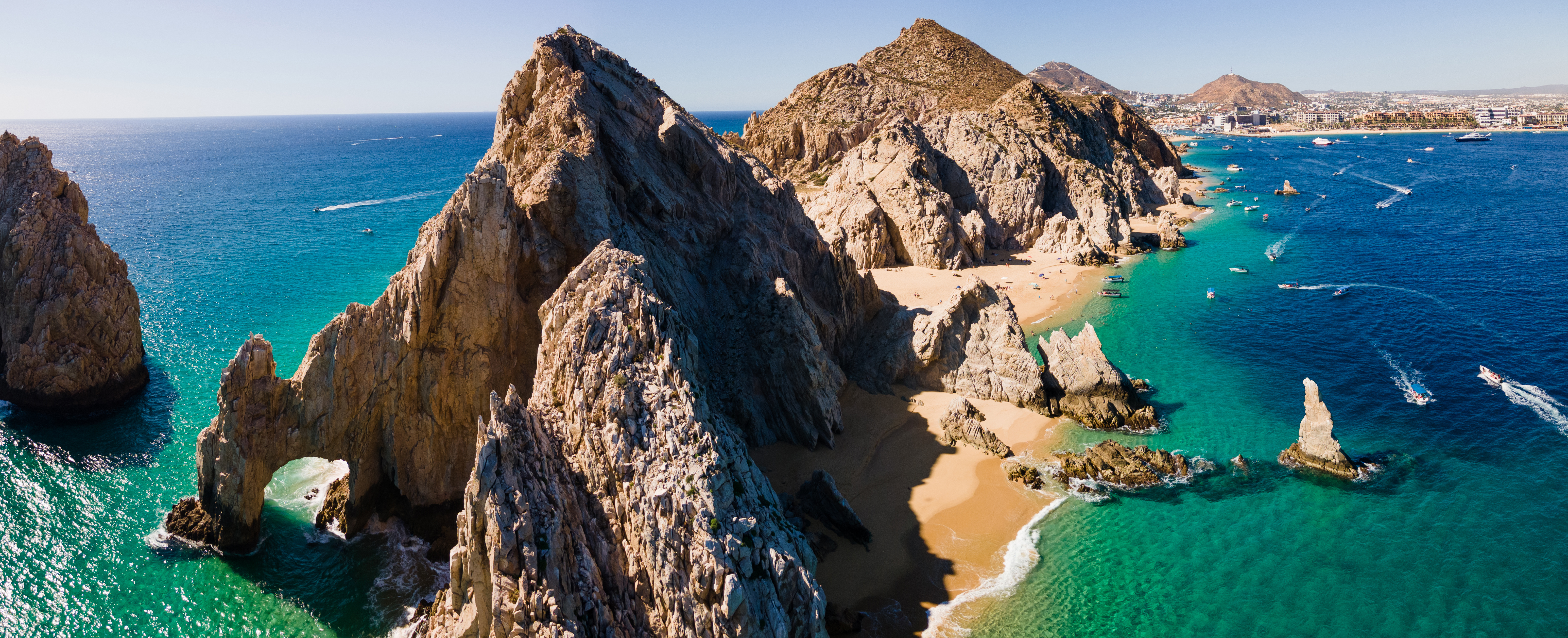
The Baja California Peninsula extends roughly 1,250 kilometers south from the US border. It runs between the Pacific Ocean to the west and the Sea of Cortez to the east, a body of water approximately 1,100 kilometers long and up to 240 kilometers wide. Los Cabos sits at the southern tip of that peninsula.
There is no road connecting the Baja Peninsula to mainland Mexico. The only surface route from the mainland to Los Cabos is by ferry, crossing from Mazatlán or Topolobampo on the Mexican mainland across the Sea of Cortez to La Paz, then two hours south by road to Los Cabos. That crossing takes most of a day under ideal conditions.
The physical relationship between Los Cabos and mainland Mexico is not that of neighboring cities sharing a highway. It is separated by the Sea of Cortez in a way that makes it function, logistically, like an island. A very well-connected island with 32 nonstop US flight routes, but an island nonetheless
This is not a technicality. It is the single most important geographical fact about this destination, and it was almost entirely absent from the coverage that has caused American travelers to pause.
What happened at the beginning of 2026 and Why It Didn't affect Los Cabos
The incidents that dominated North American news in February 2026 were real. Gang-related violence following a Mexican military operation created serious disruptions centered in Jalisco and spreading to several other mainland states. Major disruptions were reported in and around Puerto Vallarta and Guadalajara. The concern that was generated was understandable.
What the coverage didn't explain is where these places actually are relative to Los Cabos.
Cabo San Lucas and Puerto Vallarta, the city at the epicenter of the February disruptions, are roughly 1,000 miles apart by road. US Embassy safety alerts issued during this period were limited specifically to the affected mainland regions. Baja California Sur was not included.
Our team was here through all of it. The mornings looked the same. The airport was operating normally. Guests were arriving, checking in, and going to dinner. The headline Mexico and the Los Cabos we work in every day were two different places, not because we were lucky, but because they always are.
What Does the Safety Data Show for Los Cabos in 2026?
Mexico's National Institute of Statistics and Geography, known as INEGI, publishes a quarterly survey measuring residents' sense of safety across 91 Mexican cities. The Q1 2026 data show that Los Cabos has a perception of insecurity at 34.7%. The national urban average is 61.5%. Los Cabos consistently ranks among the lowest in the country for resident-reported insecurity.
One thing worth being honest about: in Q1 2025, the Los Cabos figure was 24.7%. The increase to 34.7% in Q1 2026 is real, and it tracks directly with the February news cycle. Perception shifted faster than local conditions warranted. That pattern, national headlines moving local sentiment, shows up across every major destination that shares a country name with a difficult story.
The traveler data tells a different story. Cabo San Lucas currently holds a Traveler Safety Index score of over 90 out of 100 based on verified reports from visitors on the ground, and has been ranked the second safest international destination for 2026 by 5,000 American travelers.
The US State Department advisory for Baja California Sur is Level 2, Exercise Increased Caution. That is the same advisory level assigned to France, Italy, the United Kingdom, and Germany.
How Do American Travelers Actually Get to Los Cabos?
Directly. That's the part that surprises people who picture flying to Mexico as passing through a mainland hub.
Los Cabos has nonstop service from 32 US cities, including Los Angeles, San Diego, San Francisco, Dallas, Houston, Austin, Phoenix, Denver, Las Vegas, Seattle, Chicago, Atlanta, New York, and Washington, D.C. A traveler boarding a flight in any of those cities lands directly at San José del Cabo International Airport in Baja California Sur, without connecting through any mainland Mexican city at any point in the itinerary.
The flight map is its own geography lesson. It makes it clear, in the most practical way possible, that Los Cabos is not a stop on a journey through Mexico. It is a direct destination with its own access, its own infrastructure, and its own reality on the ground.
What Our Team Actually Sees Here
Our concierge and villa rental teams live and work in Los Cabos. That sentence gets used a lot in destination marketing and usually means very little. Here, it means something specific.
It means that in February 2026, while news coverage was at its peak, our concierge team was confirming dinner reservations at El Farallón and arranging whale-watching departures from the marina. Our villa rental team was fielding calls from guests who had seen the headlines and calling back with a real read, not reassurance, not spin, but an honest account of what was actually happening on the ground. Which was, in most cases, nothing that affected a stay in Los Cabos.
That kind of information only exists when your team actually lives in the destination. It cannot be replicated by a platform, an algorithm, or a remote booking service. And when conditions here do change in ways that matter for a guest's trip, we say so. That commitment to honesty is why we're giving you the full picture now, including the parts that are more complicated than a simple yes or no.
Los Cabos is safe in 2026. It has been throughout. And our team is the most direct line to what that actually looks like on any given day.
Safety Frequently Asked Questions
Is Los Cabos safe for American tourists in 2026?
Yes. Resident safety surveys, US State Department advisories, and verified traveler sentiment all place Los Cabos among the safest destinations in Mexico and one of the safest international destinations for American travelers. Cabo San Lucas was ranked the second safest international destination for 2026 by 5,000 American travelers.
Is Los Cabos connected to mainland Mexico by road?
No. The Baja California Peninsula is separated from mainland Mexico by the Sea of Cortez. The only surface connection is by ferry, crossing from Mazatlán or Topolobampo to La Paz, followed by a two-hour drive south to Los Cabos. Most travelers arrive by direct nonstop flight from the United States.
Was Los Cabos affected by the February 2026 mainland incidents?
No. The February 2026 incidents were centered in Jalisco and spread to several other mainland Mexican states. US Embassy safety alerts were limited to those specific mainland regions. Baja California Sur, where Los Cabos is located, was not impacted. Our team was operating normally throughout.
What is the US State Department advisory for Los Cabos?
Baja California Sur carries a Level 2 advisory, Exercise Increased Caution, the same level assigned to France, Italy, the United Kingdom, and Germany.
Are there direct flights to Los Cabos from the United States?
Yes. Los Cabos has nonstop service from 32 US cities, including Los Angeles, Dallas, Houston, Phoenix, Denver, Chicago, New York, Atlanta, Las Vegas, and Seattle. Travelers fly directly to Baja California Sur without connecting through any mainland Mexican city.
How does Cabo Luxury's team stay current on conditions in Los Cabos?
Our concierge and villa rental teams live and work here year-round. When guests ask whether now is a good time to visit, we answer based on what we see on the ground, not on what sounds reassuring.
If you're weighing whether this is the right moment to plan a trip to Los Cabos, our team can give you an honest, current read on what the destination looks like right now. That is one of the things being local actually means.